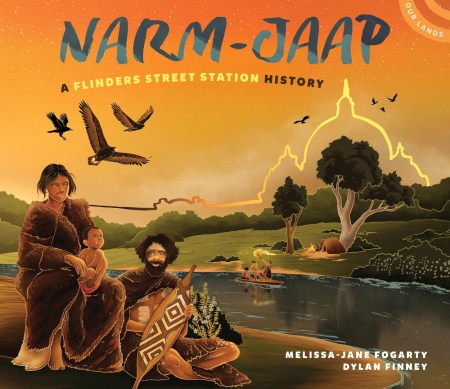
An engaging and comprehensive history of one of Australia’s most prominent landmarks, Flinders Street Station, and the land on which it is built.
This is the story of Narm-Jaap.
Flinders Street Station in Melbourne is a modern Australian icon, but the land on which it stands has a long history. We step back in time to when Narm-Jaap was a meeting place for the people of the Kulin nation, and follow along as the land is claimed by the colonisers. We witness Narm-Jaap through its evolution and many forms, but through it all, it remains a bustling epicentre of community and a place of meeting.
Our Lands is an Indigenous history series about Australia’s most iconic landmarks and the land on which they are built.
‘A powerful re-framing of one of Melbourne’s most recognisable landmarks. . . [Fogarty’s] work centres culture, place, and connection, inviting younger audiences in particular to engage with history in more expansive and meaningful ways’ NATIONAL INDIGENOUS TIMES
‘Invites readers to reconsider Flinders Street Station not just as a transport hub but as a site of deep cultural and historical significance’ INDIGENOUS NEWS AUSTRALIA
‘Compelling and comprehensive . . . Through lush illustrations and engaging storytelling, Fogarty and Finney send us back in time to an important meeting place for the Kulin nation, through colonisation, industrialisation, and into the present day. This timely and thoroughly-researched book will be the perfect gift for curious guests and local history buffs alike!’ READINGS
‘Timely and thought-provoking, Narm-Jaap opens up broader conversations about place, memory, and how Melbourne understands its most iconic landmarks’ THE NATIONAL TRIBUNE
‘An important book . . . Both the story and the illustrations are warm and inviting, giving us an understanding of how a place of Indigenous life and gathering transformed to feature one of the most recognised buildings in the world’ GOOD READING MAGAZINE
This is the story of Narm-Jaap.
Flinders Street Station in Melbourne is a modern Australian icon, but the land on which it stands has a long history. We step back in time to when Narm-Jaap was a meeting place for the people of the Kulin nation, and follow along as the land is claimed by the colonisers. We witness Narm-Jaap through its evolution and many forms, but through it all, it remains a bustling epicentre of community and a place of meeting.
Our Lands is an Indigenous history series about Australia’s most iconic landmarks and the land on which they are built.
‘A powerful re-framing of one of Melbourne’s most recognisable landmarks. . . [Fogarty’s] work centres culture, place, and connection, inviting younger audiences in particular to engage with history in more expansive and meaningful ways’ NATIONAL INDIGENOUS TIMES
‘Invites readers to reconsider Flinders Street Station not just as a transport hub but as a site of deep cultural and historical significance’ INDIGENOUS NEWS AUSTRALIA
‘Compelling and comprehensive . . . Through lush illustrations and engaging storytelling, Fogarty and Finney send us back in time to an important meeting place for the Kulin nation, through colonisation, industrialisation, and into the present day. This timely and thoroughly-researched book will be the perfect gift for curious guests and local history buffs alike!’ READINGS
‘Timely and thought-provoking, Narm-Jaap opens up broader conversations about place, memory, and how Melbourne understands its most iconic landmarks’ THE NATIONAL TRIBUNE
‘An important book . . . Both the story and the illustrations are warm and inviting, giving us an understanding of how a place of Indigenous life and gathering transformed to feature one of the most recognised buildings in the world’ GOOD READING MAGAZINE